Finally, somewhere to put your drink beside the beach chair.
122 reviews · 4.9 average · 98 verified purchases
Steadi Labs LLC — Scott Rodriguez, founder. Veteran founded.
3419 E Chapman Ave #411, Orange, California · hello@steadilabs.com
“First time I have ever ordered from Facebook feed. Very easy. Happy with product.”Steve Butler · 8 August 2026
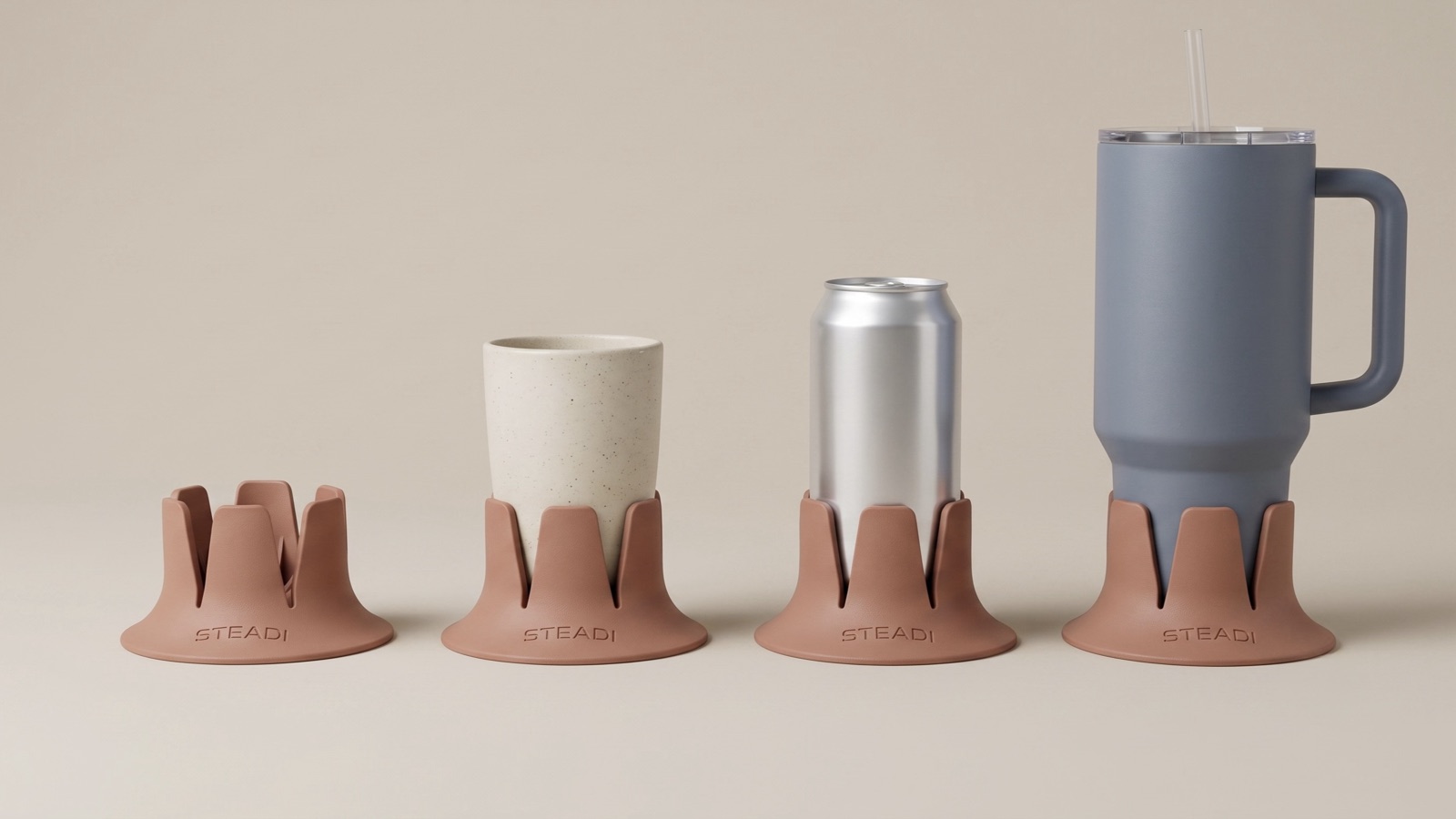
A wide flexible-finned base sits right on the sand beside your chair, holding your can, bottle, or 40 oz tumbler steady through the recline, the sprinting kids, and the 2 PM breeze.
Get one before the next beach day — from $14.95Fits the 40 oz Stanley · free shipping · 90 days on your sand to send it back
Will it fit where the armrest holder won't? A sticky note answers it — the test is below ↓
The moments
You've had this exact beach day.
The chairs are down, the umbrella screw needs both hands, so the first cold can gets twisted into the sand to wait. By the time the canopy opens, it's leaning hard with a crust of grit dried onto the side it was sweating from.
Hat over your eyes, book on your chest, drink somewhere down past your hip. Every sip means sitting all the way up, leaning, and feeling around in the sand — so the sips stop, and the ice melts by itself.
One cuts through camp chasing a ball or a wave, one heel-spray of dry sand across the towels — and the open can catches it. Everyone on this beach has flinched through that next swallow.
The sea breeze swings onshore and stiffens, the way it does every clear afternoon. The half-empty slim can goes over on the first real gust, and suddenly sandals and sunscreen bottles are pinning down everything light in camp.
Somebody wants a refill, and the drinks parked on the lid get picked up, held in the air, and re-parked one-handed. By the third round, someone just sets theirs in the sand and accepts what's coming.
What fits
The bottom inch decides what stands in the sand.
One rule sorts the whole cooler: a container base 2 to 3 inches across settles in. Here's how the usual beach-day lineup shakes out.
- Stanley 40 oz H2.0 FlowState Quencher fits
- Yeti Rambler 30 oz fits
- Standard 12 oz can fits
- Slim seltzer can fits
- 16.9 oz plastic water bottle fits
- Insulated steel bottle fits
- Sports-drink bottle fits
- Kids' straw cup fits
- Snack-shack fountain cup check the base
- Coffee mug, handled handle in the way
The floor is as real as the ceiling — under 2 inches, a base sits too loose in the fins. The handled mug is the honest no: its base is fine, but the handle lands exactly where a fin needs to grip. And the koozie is a case-by-case — foam widens a can's footprint, so run the sticky-note test with it on.
The full fit database — Stanley, Red Bull, Yeti, and 30 more, with sourced base measurements →
Versus what you do now
Against everything that's already ridden down in the wagon.
| The beach chair's built-in cup holder | The Beach Chair Cup Holder | |
|---|---|---|
| Takes the 40 oz tumbler | Sized for a can, not a tumbler | Fits — sized for the tumbler too |
| Holds when a chair leg sinks | Tilts right along with the chair | settles back down on its own |
| Survives a full season in the sun | Mesh stretches out and quits gripping | One molded piece, nothing to stretch |
| Holds when you shift or stand | Shallow ring lets go and spills | Holds steady through the shift |
| Works on the cooler lid too | Built into this chair, nowhere else | Works there too, same base |
| Moves when camp moves | Stays on this chair, not the next one | One grab, comes along |
| Cost | Came with the chair already | One small piece, a separate purchase |
A screw-in stake whose stability depends entirely on the planting: the usage guidance says to tamp wetter sand and nest it against a chair leg — which concedes what it does in dry fluff. It parks the drink at ankle height, still a reach from a recline, a snug cup can pull the whole stake out with it, and cheap molded versions have drawn sun-warp complaints.
The holders are the afterthought on a chair engineered around lying down. The recurring reports: mesh stretches out and quits gripping, shallow rings spill when the sitter shifts or stands, and 30 and 40 oz tumblers don't fit at all. On sand there's a failure no spec sheet mentions — the moment a leg sinks, the holder leans with the chair.
Fit depends on your chair's tubing, cheaper clamps are reported to loosen over time, and add-on mounts can let go in use or in transit. A mount that rotates under a full drink hands it straight to your lap.
Four skinny legs, four different sink rates: the top ends up tilted and everything on it slides to the low corner. It also claims the space between the chairs, and it's one more bulky thing to haul on the walk-down.
From the reviews
What buyers say.
Real reviews of the Steadi — these ones mention beach life.
OMG!!!!! YOU HAVE TO BUY THESE!!!!!! i tested it out today on an old tv tray (wood and very slippery) and put a soda in it and played like “oops i bumped my tray” (and really hard) and NADA, NOPE, NOT AN INCH OF MOVEMENT from the STEADI. everything else went flying!!! cuz dummy me didn’t remove those other items first 🙃 duh!!! and no it was not suctioned to my tray cuz it doesn’t do that. but WOW!!!!! what a great invention. wish i was thinking up this GREAT IDEA, instead of binge watching TRAITORS tv shows and SPILLING my soda as i jump with excitement/anger over the show. the plus side, while flipping thru FB (while the commercial is on) or i’m cleaning up my spilt soda 🤪….. i saw this ad and it was like angels were singing “BUY ME AND UR PRAYERS ARE ANSWERED”. so glad i did. they work great!!! i bought the 4ct from actual website and it shipped quick and packaging was perfect. all 4 colors are great!! black, white, deep terracotta (plant holder) color. very very nice color. especially during the fall. and a muted warm sage color. very nice also. FYI:: i forgot to mention, i even tested this out with a 8oz dinner cup and it worked perfectly. but put the cup in FIRST then add beverage…..LOL learn from my dumb remark of “i can get it around the cup filled to the brim and not drop a lick of this drink. well WRONG!!!! 😑 LOL!!! user error not the STEADI. buy this and trust me u won’t want to return it. oh and it is comfortable to hold. and actually, now i can set my can of soda down with a mighty slap on the table and a huff and puff in disgust, if my tv show is calling for my dark side to come out in anger, of their decision of who to banish on TRAITORS (US/UK/NZ/ and now CANDA)!! ENJOY!!!! and THANK YOU TO THE INVENTOR!!!!! i hear it’s a father of 3. 🤷♀️
rebekah q. · 2026-06-23Steadi- Just what I was looking for! I purchased these to use at our annual NASCAR race this month. They delivered beyond my expectations. Our seats are metal benches with a slight slope towards the back, making it impossible to set down any type of drink. We were able to use these for a 20oz bottle with a koozie on it as well as a slim can with an insulated Brumate on it! They worked perfect, holding our drinks on the bench & on our cooler. I highly recommend for sporting fans, boaters, outdoor adventures. Thanks for making these!
Holly J. · 2026-06-09Steadi works very well in stabilizing my drinks on soft surfaces, like the couch or by the chair I use as a nightstand.
Marie A. · 2026-07-02My Steadi order arrived just as we were packing for our annual three generation family vacation. So into the car they went. Our time away is at a rental property and preventing spills in someone else’s house seems like a good goal. Additionally, most of our time is spent outside, at the house and nearby parks. The
Haila B. · 2026-05-3198 of the 122 published reviews are for the drink base itself. The other 24 are about ordering, shipping and customer service.
Ninety days, real sand included.
Take it to the beach for a month. If it doesn't do what this page says — on your sand, with your cups — email hello@steadilabs.com and it gets made right. No forms, no fight.
Veteran-founded · Patent pending · Made in Orange, California
Why more than one
Two identical tumblers. Whose is whose?
At a camp with more than one Stanley in the wagon, every tumbler looks the same the second condensation beads down the side. Someone's kid grabs the wrong cup, someone takes a sip mid-sentence and realizes it isn't theirs, and the whole camp pauses mid-recline to sort it out.
Build your set
Give everyone their own.
Pick a pack, then give each one a color — so nobody has to ask which drink is theirs.
Fair questions
You're probably thinking…
Fair — you've probably already returned one that fit that description. This one's demoed in actual wind and loose sand next to a real backpack chair, not a studio table, and the reviews carry un-staged, sandy photos instead of catalog shots. Judge it the same way you'd judge anything else: real conditions, not a clean tabletop.
Because that one's an afterthought. The mesh sling stretches out and quits gripping, the molded ring is too shallow for a 30-40 oz tumbler, and the whole holder tilts the moment one chair leg sinks into the sand. This sits on the sand itself, not on the chair, so a sinking leg doesn't take your drink down with it.
The 40 oz Stanley fits. So does the Yeti Rambler 30 oz. Run the 30-second sticky-note test at your own kitchen counter before it even ships — a standard square sticky note is 3 inches, the same ceiling this is built to.
Nothing here plants or stakes into anything. It lies flat on top of the sand right where your hand already falls off the armrest, so there's nothing to drive in, tamp down, or reach for.
Free shipping and a 90-day guarantee make it a no-risk add — and it costs less than one more tumbler refill lost to the sand, or the clip-on mount already gathering grit in the garage.
The paper test
The fit test is a sticky note on the kitchen counter.
lands in here
A square sticky note: 3 inches, exactly — the same ceiling the fit test uses, no ruler required on the sand.
The classic square sticky note is exactly 3 inches on a side. That's a fact about sticky notes — and it happens to be precisely the ceiling of what fits.
Test the one that actually makes the trip — the big tumbler, the seltzer can, the kid's cup. Look at the base, not the rim: beach tumblers taper and fountain cups flare, and only the bottom tells the truth.
Base inside the lines? It fits. Hanging over the edges? Too wide. A little dot adrift in the middle — under 2 inches? Too narrow.
Thirty seconds the night before, while the cooler's still in the garage — and nobody finds out at the beach.
Ask first
Asked on the walk-down, answered here.
Does it actually hold up in dry, loose sand?
That's its home ground. Soft, uneven, shifting surfaces are what the shape is for: the wide, low footprint spreads over the loose grains instead of drilling a socket, the fins hold the drink by its bottom inch, and when the sand re-settles underneath, the base settles with it and brings the drink back level.
What about the afternoon wind?
The sea breeze mostly beats tall, light, half-empty containers standing on their own — the slim can is its favorite victim. Gripped low in a wide base, that same can resists tipping and holds steady through the gusts. It's not a force field — a direct hit from a stray frisbee is its own event — but wind pushing on a drink is exactly the load it's built for.
Will the 40 oz tumbler fit? It doesn't fit my chair.
That's the one this is sized for. Judge the bottom, not the rim: a base 2 to 3 inches across settles in, and the 40 oz Stanley does. Handled mugs are the exception — the handle lands where a fin needs to grip.
Can the can stay in its koozie?
Case by case. Foam widens the can's footprint and koozies vary, so run the sticky-note fit test with the koozie on — base inside the 3-inch square fits. A bare 12 oz can fits.
Doesn't it just fill up with sand?
Sand rinses right out. It's one piece of flexible molded material — no mesh to trap grit, no seams, nothing to come apart. Shake it out at the car, rinse it at the beach shower, or wipe it down at home, or put it in the dishwasher. Sand and a soaking don't hurt it.
Does it attach to the chair?
No — nothing clamps to tubing, nothing stakes into the beach. It sits on the sand wherever your hand naturally falls from the chair, the spot the ankle-height spike and the armrest ring both miss. On the walk-down it packs flat in the wagon or the chair's backpack pouch.
Can I use it on the cooler lid?
Yes — it works at least as well on hard, flat surfaces. The wide footprint and the grip keep a bottle from skating on the condensation film, and a gust that would sweep a light can off the lid meets a drink held low and steady instead.
What about the kids' drinks?
Straw cups and small bottles settle in as long as the base lands in the about-2-to-3-inch range — the sticky-note test works on their cups too. No cup holder can save the juice pouch.
Who makes it, and where do I get one?
It's called the Steadi, molded in small runs in Orange, California by Steadi Labs — veteran-founded and patent pending. Orders ship free from steadilabs.com, and you get 90 days to change your mind.
Who makes it
Onshore in more ways than one.
The maker is Steadi Labs, a small veteran-founded company in Orange, California. It's injection molded in small runs, and nothing about it travels far — the mold, the material, and the color runs all sit within about three and a half miles of the shop, packed tighter than the wagon on the walk-down. The people who make it read hello@steadilabs.com themselves, usually before the cooler's even loaded.
Keep the cold one out of the sand.
The drink stands level in the soft sand, right where your hand falls from the chair — through the recline, the cooler runs, and the two o'clock breeze — and the grit stays on the beach where it belongs.
Get one before the next beach day — free shipping, alwaysCheckout is on steadilabs.com — Steadi Labs is the company that makes it.